
How to Vet Reputable Telehealth Providers for Longevity Peptides and NAD+: 503A Pharmacy & FDA Safety Standards
As patient demand for longevity injectables, specifically nicotinamide adenine dinucleotide (NAD+), the sermorelin peptide, and glutathione, surges in 2026, choosing between telehealth providers has become a safety decision, because the online medical landscape has split into two distinctly different ecosystems. On one side are unregulated research-use-only vendors and transactional prescription mills. These grey-market operators sell unapproved lyophilized powders labeled "not for human consumption" alongside web portals that obscure their pharmacy sourcing and lock patients into deceptive subscription contracts.
On the other side are clinician-led telehealth platforms partnered exclusively with accredited 503A compounding pharmacies. In this strictly regulated space, state-licensed medical professionals review comprehensive patient histories, prescribe eligible bulk drug substances, provide longitudinal ongoing care, and fulfill patient-specific prescriptions through a highly regulated home delivery pharmacy.
Navigating this complex landscape requires a stringent clinical vetting process. Evaluating telehealth providers for longevity therapeutics means looking past aggressive marketing claims to demand explicit regulatory compliance. Patients and clinicians must verify FDA Section 503A bulk drug substance compliance, demand total transparency regarding sterile compounding standards, and ensure ongoing clinical oversight. This guide explains how to identify trustworthy telemedicine platforms, the critical legal difference between legally compounded prescription therapeutics and banned experimental chemicals, and why continuous medical supervision is an absolute necessity for anti-aging and recovery protocols.
What makes longevity peptide and NAD+ telehealth providers reputable
When vetting reputable telehealth doctors for longevity peptides and NAD+, patients should verify three non-negotiable standards: prescriptions must be limited to FDA Section 503A-eligible substances (such as Category 1 NAD+ and glutathione, or sermorelin under the FDA's 2013 Geref determination), medications must be dispensed by a named, LegitScript-certified 503A pharmacy rather than 'research-use-only' chemical vendors, and the platform must provide ongoing provider messaging for personalized dose titration.
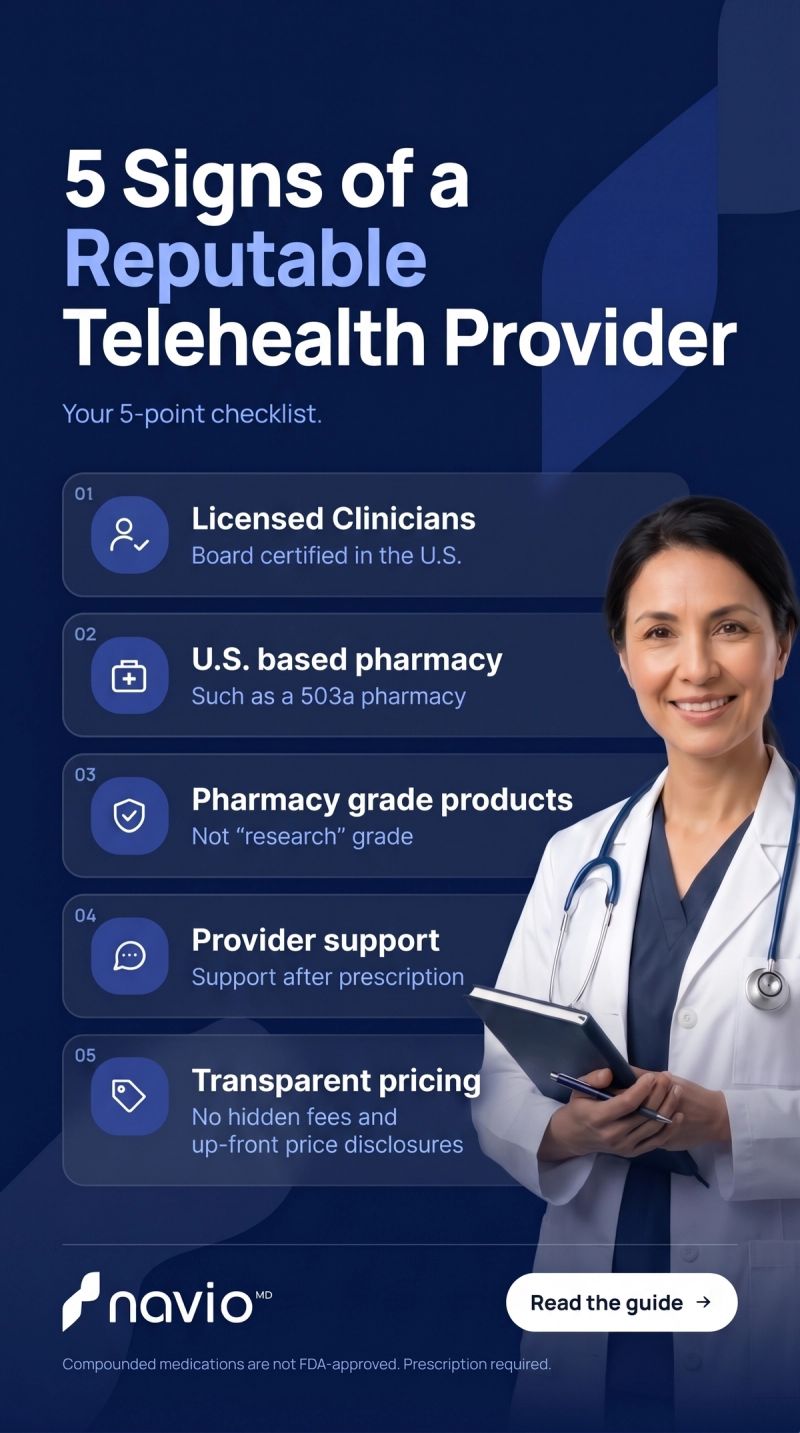
Both the U.S. Food and Drug Administration (FDA) and independent industry watchdogs such as the Peptide Alliance evaluate digital clinics across highly specific safety, clinical, and commercial criteria. To separate legitimate medical practices from unsafe grey-market vendors, patients must apply a rigorous five-point clinical vetting framework:
- Valid Prescription Gating and Licensed U.S. Clinicians: Reputable telehealth providers require a thorough health intake reviewed by a state-licensed physician (MD or DO), nurse practitioner (NP), or physician assistant (PA) before any medication is approved, compounded, or billed. The FDA's telehealth consumer safety guidance explicitly warns consumers to avoid online platforms that do not require screening by a licensed doctor or that fail to provide a licensed healthcare provider to answer questions after medication delivery.
- Named U.S. 503A Compounding Pharmacy Partner: Trustworthy telehealth providers openly identify their specific dispensing pharmacy in their terms and clinical disclosures, rather than hiding behind vague "partner pharmacy network" language. According to the November 2026 Peptide Alliance Standard v1.1, strict pharmacy identification (Criterion S3) and explicit compounding disclosures stating that compounded formulations are not FDA-approved (Criterion S4) are core, non-negotiable requirements for compliant telehealth operations.
- Strict Adherence to FDA Section 503A Eligibility Lists: Legitimate medical providers only prescribe compounds that meet federal criteria under Section 503A of the Federal Food, Drug, and Cosmetic Act (FD&C Act). This ensures patients only receive vetted therapies, such as NAD+ and glutathione (currently recognized as FDA 503A Category 1 substances) and sermorelin (recognized legally as a component of a previously FDA-approved drug not withdrawn for safety or effectiveness).
- Ongoing Provider Messaging and Dose Titration: Injectable longevity protocols require individualized dosing and continuous side-effect monitoring. For example, managing transient flushing or nausea associated with NAD injections requires clinical calibration. Reputable platforms include unlimited direct provider messaging and periodic clinical check-ins to monitor patient progress, rather than facilitating one-off transactional prescriptions.
- Transparent, Upfront Pricing Without Membership Traps: Trustworthy clinics publish real, accessible dollar figures on their public product pages. They include all necessary injection supplies and shipping in the listed price and allow month-to-month flexibility. They actively avoid hidden recurring membership fees, bait-and-switch introductory rates, or mandatory twelve-month lock-in contracts.
Understanding FDA regulations on compounded peptides vs. banned research-grade chemicals
A critical point of confusion for patients, and a highly important topic for safety, is the legal and clinical distinction between patient-specific 503A compounded medications, FDA Category 2 restricted substances, and highly dangerous unapproved research-grade chemicals.
Under Section 503A of the FD&C Act, state-licensed physicians and pharmacists may only compound drug products using bulk drug substances, also known as Active Pharmaceutical Ingredients (APIs), that meet one of three strict statutory pathways. The substance must comply with an applicable United States Pharmacopeia (USP) or National Formulary (NF) monograph, be a component of an FDA-approved drug product, or appear on the FDA's 503A Bulks List or fall under the agency's interim enforcement discretion policy as Category 1: Bulk Drug Substances Under Evaluation. Furthermore, the FDA mandates that every bulk drug substance used by a 503A pharmacy must be accompanied by a valid Certificate of Analysis (COA) and manufactured by an FDA-registered establishment under Section 510 of the FD&C Act.
The regulatory standing of core longevity therapies as of November 2026 is clearly delineated:
- NAD+ (Nicotinamide Adenine Dinucleotide): This coenzyme is explicitly listed on the FDA's 503A Category 1 list under the agency's interim policy, permitting patient-specific prescription compounding by state-licensed 503A pharmacies.
- Glutathione: Listed on the FDA's 503A Category 1 list and supported by rigorous USP compounding standards, glutathione is fully permitted for patient-specific prescription compounding.
- Sermorelin Acetate: This peptide was originally FDA-approved as Geref under NDA 19-863 in 1990 and NDA 20-443 in 1997. The manufacturer voluntarily discontinued it between 2008 and 2009. In a landmark March 4, 2013 Federal Register determination (78 FR 14095), the FDA formally ruled that Geref was not withdrawn from sale for reasons of safety or effectiveness. Legal analyses from the Health Law Alliance and Peptide Policy Watch confirm this ruling preserves its lawful eligibility for 503A compounding as a component of an FDA-approved drug.
In stark contrast, the FDA maintains a list of Certain Bulk Drug Substances for Use in Compounding that May Present Significant Safety Risks (Category 2). Historically, several unvetted growth hormone secretagogues, such as GHRP-2, GHRP-6, CJC-1295, and Ipamorelin, were placed on this restrictive list due to severe immunogenicity concerns, cardiovascular events, or a complete lack of human safety data.
While an October 30, 2026 draft notice from the Department of Health and Human Services (Docket No. HHS-OASH-2026-0496) proposed conditional enforcement discretion for six specific experimental peptides (BPC-157, Epitalon, KPV, MOTS-c, Semax, and TB-500), legal scholars at Polsinelli PC reported in The National Law Review that this policy imposes stringent sourcing, testing, and adverse-event reporting barriers well beyond standard Category 1 rules. Most importantly, it does not legalize research-use-only peptides. This legal reality is why conservative medical platforms focus heavily on how sermorelin works compared to unapproved secretagogues rather than prescribing experimental alternatives.
Throughout 2025 and 2026, the FDA escalated enforcement against online vendors selling unapproved injectable peptides labeled "For Research Use Only" (RUO) or "Not for Human Consumption." In severe warning letters to vendors including NuScience Peptides LLC (August 24, 2026), Prime Sciences (March 31, 2026), and Gram Peptides (March 31, 2026), the FDA ruled that printing "For Laboratory Research Only" on a vial does not exempt a seller from the FD&C Act when the marketing implies human health benefits.
The FDA emphasized that injectable products are delivered directly into the body and bypass key physiological defenses against toxins and microorganisms. As stated in a February 2025 warning letter to USApeptide, drugs that circumvent regulatory safeguards may be contaminated, counterfeit, or contain completely different ingredients. Clinical contamination risks include deadly bacterial endotoxins (lipopolysaccharides), toxic trifluoroacetic acid (TFA) synthesis salts used in cheap manufacturing, and heavy metal exposure.
Why 503A pharmacy accreditation and sterile compounding standards matter
Even when a therapeutic molecule is entirely legal to prescribe, a patient's safety depends completely on the pharmacy that prepares, tests, and ships the final vial. A Section 503A compounding pharmacy is a highly regulated state-board-licensed facility where licensed pharmacists compound customized medications exclusively in response to an individual, patient-specific prescription from a licensed practitioner.
When evaluating a telehealth provider's fulfillment network, patients and prescribers should demand five verifiable safety benchmarks:
- USP General Chapter <797> (Sterile Compounding Compliance): Administered and heavily inspected by state boards of pharmacy and the National Association of Boards of Pharmacy (NABP), USP <797> governs all sterile preparations, including subcutaneous and intramuscular injectables. Compliance mandates maintaining ISO-classified cleanroom air quality, strict aseptic preparation protocols, rigorous sterility and bacterial endotoxin (USP <85>) testing, and scientifically validated Beyond-Use Dates (BUDs) based on stability testing data.
- USP General Chapter <795> and <800>: USP <795> enforces quality, potency uniformity, and long-term stability for non-sterile preparations, while USP <800> establishes essential containment and physical safety protocols for handling hazardous drug substances.
- LegitScript Certification: This independent, third-party verification is used by major digital platforms, payment processors, and healthcare regulators to confirm that a telehealth clinic and its dispensing pharmacy maintain valid, active licenses across all operating jurisdictions while obeying federal and state prescription laws with complete operational transparency.
- Multi-State Board of Pharmacy Licensure and Clean Regulatory Records: A pharmacy shipping prescription medications across state lines must hold active Non-Resident Pharmacy licenses in every state it serves. Crucially, the facility must operate with zero unresolved FDA Form 483 inspection observations, zero federal warning letters, and zero state board disciplinary actions. The FDA's BeSafeRx program likewise advises patients to confirm that an online pharmacy is licensed by the state board of pharmacy in their state and in the state where it operates.
- Cold-Chain and Expedited Shipping Controls: Biologic peptides and complex coenzymes are notoriously temperature-sensitive. Reputable 503A fulfillment partners utilize advanced temperature-controlled packaging and secure expedited one-to-two-day shipping lanes to preserve molecular stability from the cleanroom directly to the patient's doorstep.
Clinical oversight: licensed U.S. providers and unlimited direct messaging vs. one-off prescription mills
The best online clinics for NAD injections for longevity and anti-aging combine licensed U.S. physician oversight with transparent, contract-free pricing and accredited 503A pharmacy fulfillment. For example, Navio MD provides personalized NAD+ injection protocols starting at $131 to $145 per month, including licensed provider review, unlimited care team messaging, injection supplies, and free 1-to-2-day cold-chain delivery from a U.S. 503A pharmacy, with no membership or cancellation fees.
Academic health law researchers and medical regulators raised profound alarms throughout 2026 regarding direct-to-prescription telehealth models that prioritize rapid transaction volume over actual patient care. In a landmark November 2026 study published in the UC Davis Law Review (Vol. 60:373), Professors Jacob T. Elberg from Seton Hall Law and Erin C. Fuse Brown from the Brown University School of Public Health warned of the dangers inherent in high-volume transactional platforms. They noted that in these environments, physicians function less as independent fiduciaries and more as transactional intermediaries within vertically integrated commercial pipelines. This blatant conflict of interest threatens patient safety, fragments medical care, and erodes the relational foundations of the physician-patient relationship.
Longitudinal clinical care is essential for therapies like NAD+, sermorelin, and glutathione. A comprehensive September 2026 clinical review in Frontiers in Aging (Alangari et al.) documented that while NAD anti-aging administration successfully elevates circulating coenzyme levels and modulates oxidative stress biomarkers, rapid or improperly titrated administration can trigger severe nausea, abdominal cramping, flushing, headache, and chest discomfort.
Similarly, therapies like nighttime sermorelin, which acts on the pituitary GHRH receptor during nocturnal slow-wave sleep pulses, are not generic, one-size-fits-all commodities. Patients require an easily accessible care team to adjust injection frequency, precisely calibrate milligram dosing based on tolerability and recovery goals, and seamlessly transition from prior in-clinic IV drips or previous prescriptions.
In practice, transactional "prescription mills" or grey-market vendors offer zero medical screening, relying instead on rubber-stamp auto-generated scripts with absolutely no clinical dialogue. They hide their pharmacy networks, market unapproved RUO peptides, utilize bait-and-switch pricing with mandatory 12-month lock-ins, and ship via unregulated mail without essential supplies. Conversely, reputable clinician-led telehealth providers conduct thorough health history evaluations reviewed by licensed providers, offer unlimited direct care team messaging, prescribe only eligible FDA 503A compounds, publish transparent pricing, and provide expedited delivery with all necessary sterile administration supplies included.
How Navio MD delivers clinician-guided NAD+, sermorelin, and glutathione nationwide via an accredited 503A pharmacy partner
Navio MD is a telemedicine service using 503A compounding pharmacy for home delivery that fulfills patient-specific longevity prescriptions, including NAD+, sermorelin, and glutathione, through The Pharmacy Hub, a LegitScript-certified U.S. 503A pharmacy. Every approved prescription ships directly to the patient's home in 1 to 2 business days with temperature-controlled packaging, sterile administration supplies, and unlimited access to the prescribing care team.
Launched by dedicated healthcare professionals to combine modern digital convenience with rigorous longitudinal clinical guidance, the clinic requires every prospective patient to complete a highly structured health intake. This intake covers detailed medical history, current medications, lifestyle factors, and specific wellness goals. The clinical model has been independently verified. In its November 2026 Seller Record Audit, the Peptide Alliance verified that the platform passes core regulatory and transparency benchmarks, achieving a "PASS" rating for Prescriber Requirement (S1), Prescription Gating (S2), Pharmacy Identification (S3), Compounding Disclosure (S4), Price Disclosure (S7), and FDA Enforcement Status (S8, indicating zero FDA warning letters on file). The sole criterion flagged across the industry, S5, notes that lot-specific COAs are held securely at the pharmacy level rather than published as public PDFs on retail pages.
For patients transitioning from expensive in-person IV NAD+ or glutathione lounges, the platform facilitates seamless prescription transfers. Patients can upload their current records so a licensed U.S. provider can calibrate personalized NAD+ injection protocols that pick up exactly where the previous treatment left off, supported by unlimited direct messaging and clinical check-ins at no extra cost.
The platform explicitly names The Pharmacy Hub as its exclusive U.S. 503A fulfillment partner. Operating out of Miami Gardens and Davie, Florida under FL Department of Health License #PH33959, The Pharmacy Hub maintains a clear standing with zero disciplinary actions on file as verified by the Florida DOH MQA Portal in November 2026. According to independent compliance audits by GLP Success and AffinityRx, the pharmacy operates with full LegitScript certification, strict USP <795>, <797>, and <800> alignment, HIPAA technical safeguards, Surescripts national e-prescribing integration, and rigorous cold-chain shipping controls.
Unlike telehealth providers that advertise low teaser rates while ultimately charging $99 to $149 monthly in hidden mandatory "platform membership fees," the clinic publishes completely flat, transparent pricing with no membership fees, no contracts, and no hidden cancellation fees:
- NAD+ Injection: Focused heavily on cellular energy (ATP), mitochondrial function, mental clarity, and healthy aging. The therapy is priced at $145 per month for a one-time order with no auto-renewal, or $131 per month when selecting a 3-month supply ($392 total).
- Sermorelin Injection: Designed for natural pituitary growth hormone release, deep restorative sleep, and muscle recovery. Sermorelin therapy for adults 30 and older is priced at $135 per month for a one-time order, or $122 per month on a 3-month supply ($365 total).
- Glutathione Injection: Utilizing the body's master cellular antioxidant for oxidative stress defense, detoxification, skin health, and workout recovery. Injectable glutathione is priced at $125 per month (price dependent on clinical dose) for a one-time order, or $113 per month on a 3-month supply ($338 total).
Every single box shipped includes the personalized medication vial, required sterile syringes, alcohol prep pads, a step-by-step dosing card, unlimited provider messaging, and free expedited 2-day shipping. Patients should always review official clinical safety and risk disclosures before starting any new therapeutic regimen.
Mandatory Regulatory Disclosure: All compounded formulations are prescribed by licensed U.S. providers and prepared by a licensed U.S. 503A pharmacy for an individual patient. Compounded medications are not FDA-approved, meaning the FDA does not verify the safety, effectiveness, or quality of compounded drugs prior to marketing.
Conclusion: Choosing Telehealth Providers You Can Trust
Evaluating telehealth providers for longevity therapeutics requires rigorous attention to clinical protocols and complex legal details. By demanding strict FDA Section 503A compliance, verifying the credentials of the dispensing home delivery pharmacy, and insisting on continuous longitudinal care from licensed U.S. clinicians, patients can safely access NAD anti-aging protocols and the sermorelin peptide. Avoiding unapproved research chemicals and transactional prescription mills ensures that investments in longevity prioritize long-term health, absolute safety, and measurable clinical outcomes.
Ready to Work With a Telehealth Provider You Can Verify?
Complete a quick online intake with Navio MD and a licensed U.S. provider will review your health history and build a personalized NAD+, sermorelin, or glutathione plan. Approved prescriptions are prepared by a LegitScript-certified 503A pharmacy and ship directly to your door.
Download our high-protein, high-fiber cheat sheet
A guide to grocery shopping with high-protein, high-fiber, nutrient-dense foods.

Care designedfor real life.


Copyright © 2025 NavioMD
*Based on internal patient survey. Results vary. | Not a substitute for professional medical advice. Consult your healthcare provider before starting any treatment.